Types of Metal Additive Manufacturing.
Types Of Metal Additive Manufacturing
There are several different metal additive manufacturing techniques, each with its own unique set of advantages and disadvantages. The most common types include:
-
Laser-Directed Energy Deposition:
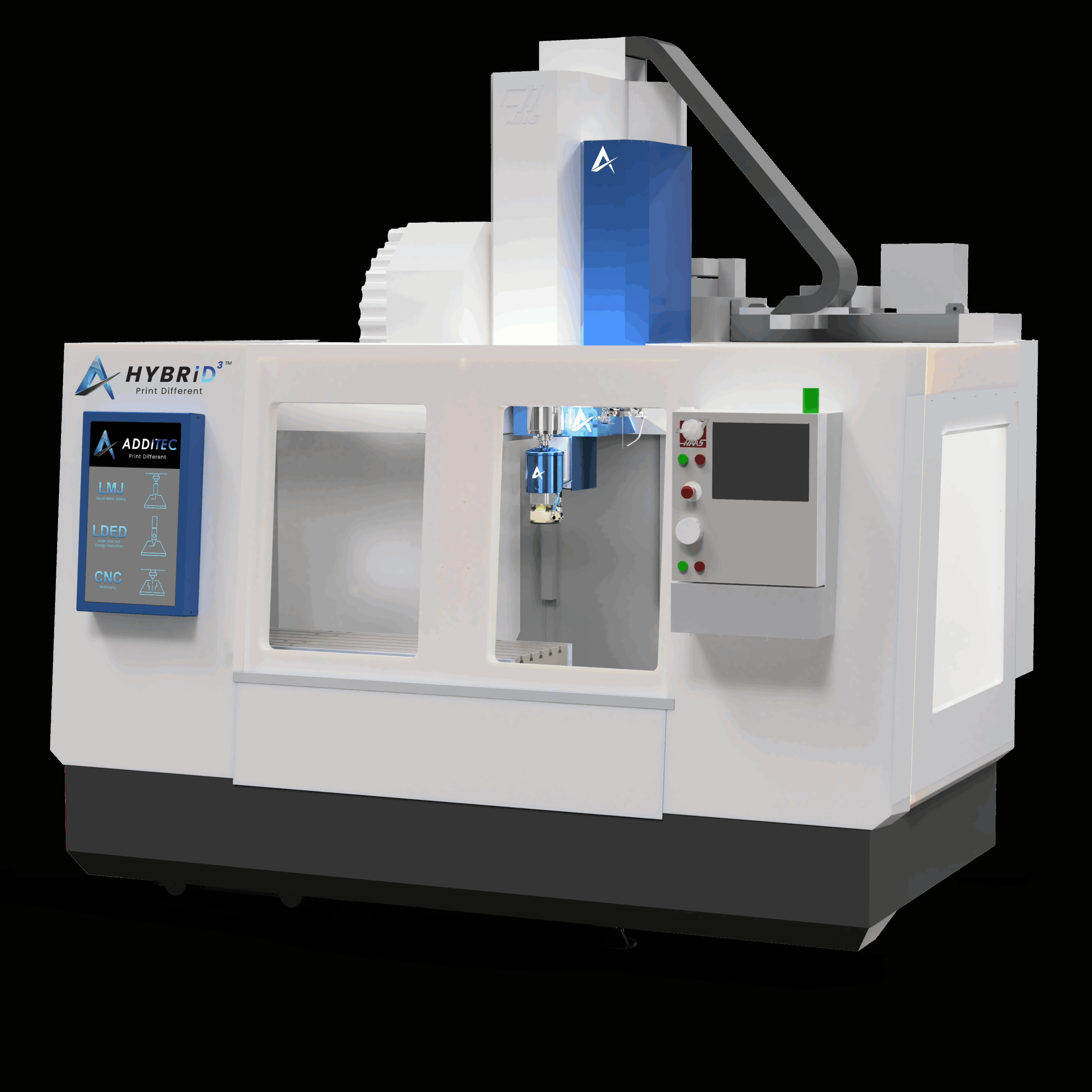
The raw material, whether in the form of wire or powder, is directed through a slender nozzle and melted by a heat source. In ADDiTEC‘s instance, we employ Wire-Laser Metal Deposition, also recognized as Laser Direct Energy Deposition (LDED). This technique involves the successive layering of weld beads as they are heated by the laser, forming a molten pool. This method is typically used for repair and restoration work and is suitable for a wide range of materials, including steel, titanium, and nickel-based alloys.
-
Liquid Metal Jetting:
This method uses standard wire materials fed into a ceramic crucible, melted, and ejected onto a heated substrate through pulsed Lorentz force. ADDiTEC‘s in-situ monitoring ensures print quality with real-time adjustments. This process eliminates the need for many 3D post-processes, reducing the time from start to part. The resulting material properties match or exceed the input material, with basic safety measures around heat and argon gas.
-
Powder Bed Fusion
This technique employs a laser to liquefy metal powders, fusing them to form the final product. It is versatile and applicable to various materials, including titanium, aluminum, and steel.
-
Binder Jetting:
In this method, a binder is utilized to bind metal powders together, subsequently fused to create the end product. Ideal for large metal parts, it accommodates a wide range of materials such as steel, titanium, and aluminum.
-
Metal Laser Sintering (MLS)
MLS, a subtype of metal additive manufacturing, selectively fuses metal powders layer by layer using a laser. This precision-driven process enables the fabrication of intricate and accurate parts with fine details.
-
Metal Sheet Lamination:
Metal Sheet Lamination, a form of metal additive manufacturing, constructs a 3D part by layering metal sheets bonded together through adhesive, welding, or other bonding methods.
-
Metal Extrusion:
This additive manufacturing type utilizes a melted metal wire or rod extruded through a nozzle to incrementally build up a 3D part layer by layer, resembling the process of Fused Deposition Modeling (FDM) with thermoplastics. Primarily employed for prototyping and low-volume production of parts like those in aerospace and automotive industries.
-
Metal FDM:
Similar to Metal Extrusion, Metal FDM utilizes a melted metal wire or rod extruded through a nozzle to build up a 3D part layer by layer. This method is preferred for prototyping and low-volume production, particularly in aerospace and automotive applications.
-
Metal Injection Molding:
Combining design flexibility from additive manufacturing with the material properties and precision of injection molding, Metal Injection Molding (MIM) involves mixing metal powder with a polymer binder, molding the mixture into the desired shape, and then sintering the part to achieve near-net-shape components. Commonly used for intricate and small parts in medical and aerospace applications.
-
Metal SLS
Metal SLS uses a laser to selectively fuse metal powders together layer by layer, akin to Selective Laser Sintering (SLS) used with thermoplastics. Primarily applied in prototyping and low-volume production for aerospace and automotive components.